
By Ashutosh Tiwari
Researcher in Demography & Population Health
International Institute for Population Sciences (IIPS), Mumbai, India.
Contact: a.tiwari@avoidable-deaths.net
Date: 28-09-2026
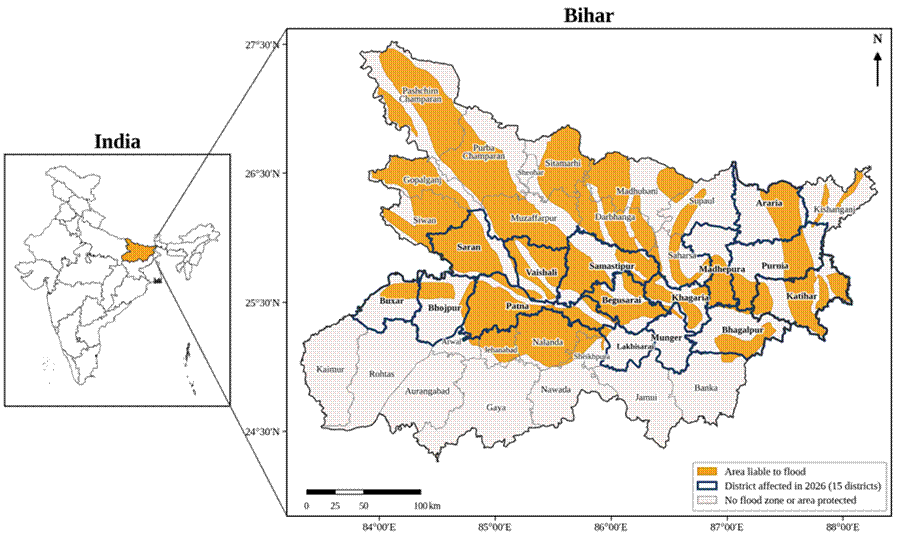
Figure 1: Areas of Bihar liable to flood (orange) and the 15 districts affected as of 14 September 2026 (blue outline). The flood-liable areas are approximate. Source: author, adapted from BMTPC and UNDP India (2008); affected districts from the state Disaster Management Department (PTI, 2026c); district boundaries from Census of India 2011.
Introduction
The 2026 monsoon began dry. Bihar witnessed three major episodes of flooding in 2026, occurring in mid-July, late August and from September onward. By mid-September, Bihar was reporting a rainfall deficit of around one-third, even as flooding affected millions of people (Mongabay India, 2026). On 5 September, the Ganga at Gandhi Ghat in Patna exceeded the previous record high set in August 2016, and about 10 lakh people across 11 districts were already affected (Business Today, 2026). By 11 September, the figure was 47.33 lakh across 15 districts (PTI, 2026a). By 23 September, 50.49 lakh people in 576 gram panchayats across 15 districts were affected (PTI, 2026d).
How many people died is still unclear. PTI reported that five people, a woman, her three children and a girl from another family, drowned in Bhagalpur on 10 September (PTI, 2026b). AFP cited local media reporting 20 deaths by mid-September (AFP, 2026). The state has also not yet published figures for crops, houses or livestock lost.
These figures indicate the number of people affected by the flood, but they do not show how many deaths afterwards might have been avoided.
This blog explores the question by tracing the chain of events linking a flood to a death. It first sets out the context of Bihar’s recurring floods. It then traces pathways from exposure to death and marks where each could be interrupted. Next, it asks why many of these deaths never appear in the flood toll. It ends with the questions the post-flood assessment should answer.
Context
Bihar is India’s most flood-prone state, with 76 per cent of North Bihar’s population living under the recurring threat of floods (Water Resources Department, Government of Bihar, n.d.). The state accounts for 16.5 per cent of India’s flood-affected area and 22.1 per cent of its flood-affected population (India Water Portal, 2008). About 73.06 per cent of Bihar’s geographical area, 68,800 of its 94,163 square kilometres, is flood-affected (Water Resources Department, Government of Bihar, n.d.; see Figure 1). Floods occur almost every year, causing loss of life and damage to livestock, homes and other assets. The past two decades show both the scale and the repetition. In 2004, floods affected more than 2 crore people and killed 885 (Water Resources Department, Government of Bihar, n.d.); in 2007, they affected over 2.4 crore and killed 1,287 (ETV Bharat, 2026a). In 2017, 1.71 crore people were affected, and 514 died (Deccan Herald, 2017). In 2024, more than 40 lakh people across 30 of the state’s 38 districts were affected (PTI, 2024), and in 2025, 38.48 lakh people across 16 districts were affected (Disaster Management Department, Government of Bihar, 2025).
The number of people affected measures the scale of exposure. It does not tell us who became ill, who could not reach care, who experienced a delay in treatment, or who died later from a condition that was never recorded as flood-related. From an avoidable-deaths perspective, those are the questions that matter most.
Exploring the chain of events
The flood exposes people to risk; this risk turns into a health emergency; a barrier delays care; the delay can lead to death. Figure 2 illustrates this chain.
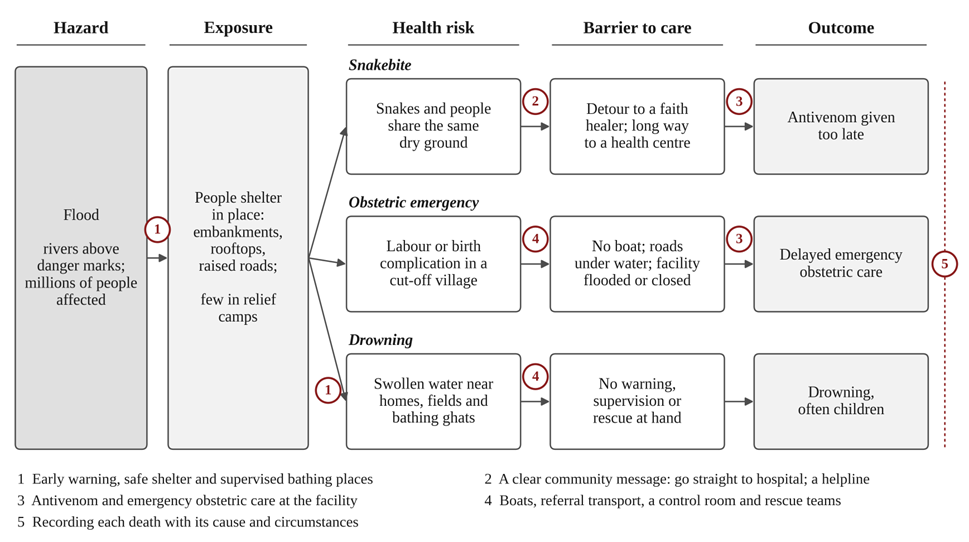
Figure 2: Conceptual pathways through which flood exposure may lead to potentially avoidable deaths from snakebite, obstetric emergencies and drowning. The numbered points mark opportunities for prevention, timely care and emergency response. Source: author, Source: author, informed by Ray-Bennett: Avoiding Disaster Deaths (2025).
Why are these deaths missing from the flood toll? Each pathway also leaves the official record at a different point, as Figure 3 illustrates
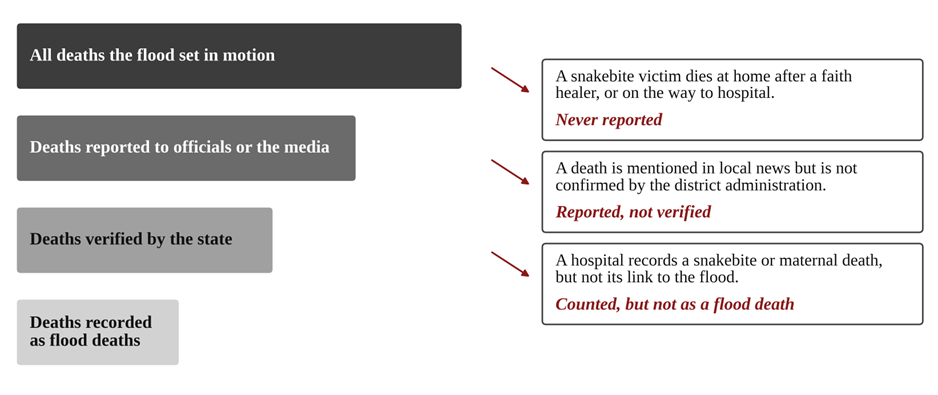
Figure 3: How deaths linked to a flood can fall out of the count. This is a hypothetical illustration; the bar lengths represent attrition and are not measured values. Source: author, Source: author, informed by Ray-Bennett: Avoiding Disaster Deaths (2025).
A more complete assessment should go beyond deaths occurring directly in floodwater. It should examine deaths from drowning and trauma alongside deaths potentially associated with delayed treatment, infectious disease, snakebite, maternal complications and disruption of essential services.
After the flood: what should we ask?
Bihar’s floodwater will recede, and the story will be told in two numbers: how many were affected, and how many died. Both will be incomplete. The first misses what families lost. The second misses the people who died weeks later of a cause that never reached a flood report.
When the official assessments come, three questions are worth asking. How many people were affected, and what did they lose? How many died, of what, and how far were they from care? And what will the state change before the next monsoon because of the answers?
A flood is a natural hazard. But the health consequences that follow are shaped by exposure, preparedness, access to care and the ability of institutions to respond. The deaths that follow it, and much of what it takes, are not inevitable.
Note: This blog does not estimate the number of indirect or delayed flood-related deaths in Bihar in 2026. Its purpose is to highlight a gap in the measurement of flood mortality and to suggest questions for examination in the post-flood assessment.
References
AFP (2026) ‘Millions affected as floods strike India’s Bihar’, The Express Tribune, 15 September. https://tribune.com.pk/story/2629463/millions-affected-as-floods-strike-indias-bihar
BMTPC and UNDP India (2008). Map showing flood zones in Bihar (as of August 2008). Data compiled by the Ministry of Urban Development and Poverty Alleviation; UNDP has not verified its accuracy. ReliefWeb, 31 August. https://reliefweb.int/map/india/india-map-showing-flood-zones-bihar-aug-2008
Business Today (2026) ‘Bihar flood alert: Ganga surpasses highest flood mark in Patna as 10.26 lakh people affected’, 5 September. https://www.businesstoday.in/india/story/bihar-flood-alert-ganga-surpasses-highest-flood-mark-in-patna-as-10-26-lakh-people-affected-553442-2026-09-05
DataMeet (n.d.) Census 2011 district boundaries, Maps repository, GitHub. https://github.com/datameet/maps
Disaster Management Department, Government of Bihar (2025) Flood/heavy rainfall report as on 23 August 2025, State Emergency Operations Centre, Patna, 25 August. https://betastate.bihar.gov.in/file_2/FileUpload/2025/Nov/17-Nov-2025/12/DyPage/c5cacdc6-975f-4539-8737-a2ce6f9a4b6c.pdf
Deccan Herald (2017) ‘Bihar gives relief to farmers’, 27 October. https://www.deccanherald.com/archives/bihar-gives-relief-farmers-2030526
ETV Bharat (2026a) ‘Bihar flood crisis: natural calamity caused by rains in Nepal, neighbouring states; is there a permanent solution?’, 5 July. https://www.etvbharat.com/en/state/bihar-floods-cause-loss-of-life-and-property-every-year-when-will-this-disaster-be-stopped-enn26070502602
India Water Portal (2008) ‘Understanding the floods in North Bihar: background and causes’, by Megh Pyne Abhiyan, 4 September. https://www.indiawaterportal.org/articles/understanding-floods-north-bihar-background-and-causes
Mongabay India (2026) ‘Floods affect millions in Bihar despite rainfall deficit’, by Ashwini Kumar Shukla, 18 September. https://india.mongabay.com/2026/09/floods-affect-millions-despite-rainfall-deficit/
PTI (2024) ‘Bihar flood situation remains grim, rivers flowing above danger mark’, The Tribune, 6 October. https://www.tribuneindia.com/news/india/bihar-flood-situation-remains-grim-rivers-flowing-above-danger-mark/
PTI (2026a) ‘Bihar flood situation grim, over 47 lakh affected across 15 districts’, ETV Bharat, 11 September. https://www.etvbharat.com/en/state/bihar-flood-situation-more-than-47-lakh-affected-across-several-districts-enn26091106658
PTI (2026b) ‘Four of family among five drown in floodwaters in Bihar’s Bhagalpur’, ETV Bharat, 10 September. https://www.etvbharat.com/en/state/several-people-drown-in-floodwaters-in-bihar-bhagalpur-enn26091006894
PTI (2026c) ‘Floods hit 4.9 million people in 15 Bihar districts as rivers keep swelling’, Business Standard, 14 September. https://www.business-standard.com/india-news/floods-hit-4-9-million-people-in-15-bihar-districts-as-rivers-keep-swelling-126091400251_1.html
PTI (2026d) ‘50 lakh people affected in 15 Bihar districts as flood crisis deepens’, ThePrint, 23 September. https://theprint.in/india/50-lakh-people-affected-in-15-bihar-districts-as-flood-crisis-deepens/3050675/
Ray-Bennett, N.S. (2025) Avoiding Disaster Deaths: Why Do So Many People Die? Cham: Springer. https://doi.org/10.1007/978-3-031-81300-9 Water Resources Department, Government of Bihar (n.d.) History of flood in Bihar, Flood Management Information System. https://fmiscwrdbihar.gov.in/fmis/history.html