
By Ashutosh Tiwari1 and Nibedita S. Ray-Bennett2
1 Researcher in Demography & Population Health, International Institute for Population Sciences (IIPS), Mumbai, India. Contact: a.tiwari@avoidable-deaths.net
Avoidable disaster deaths are deaths occurring after a disaster that could have been prevented through tailored preventive measures, appropriate medical treatment, and effective risk governance (Ray-Bennett, 2018, 2025). They occur largely from secondary impacts of disasters. For instance, a person may die because a warning never reached them, because there was nowhere safe to go, because rescue or medical ambulance came too late, or because the agencies responsible for protecting them did not work together. The hazard sets events in motion, but gaps in preparedness, care, treatment and coordination can lead to a negative health outcome such as death.
Climate change is making this more urgent. Human-caused climate change is already intensifying heatwaves, heavy rainfall, droughts and tropical cyclones in every region of the world (IPCC, 2023). Between 1970 and 2021, disasters linked to weather, climate and water caused just over 2 million reported deaths, and over 90% of these deaths occurred in developing countries (WMO, 2023). Yet the same hazard does not kill equally everywhere. Between 2010 and 2020, deaths from floods, droughts and storms were 15 times higher in highly vulnerable regions than in regions with very low vulnerability (IPCC, 2023).
Many of these deaths need not happen. In Europe alone, heat has claimed more than 200,000 lives in just four years, and the World Health Organization (WHO) states that most of these deaths were entirely preventable (WHO Regional Office for Europe, 2026). This blog explains why disaster deaths in a changing climate are avoidable, and where the chain of events that leads to them can be broken.
Three types of avoidable disaster deaths
Avoidable disaster deaths are grouped into three types, each named after the kind of measure that could have prevented it (Ray-Bennett, 2025):
- Preventable deaths could have been stopped before harm occurred, for example through early warnings, heat action plans, evacuation and safe shelter.
- Amenable deaths could have been averted through timely and effective care, such as rescue, first aid, treatment for heat stroke or continued care for chronic illness.
- Governance-related deaths happen when the agencies responsible for saving lives fail to coordinate, communicate and collaborate.
These measures depend on one another. A heat alert saves lives only if people can reach a cool place and health workers know what to do.
What is a causal pathway?
A causal pathway is the chain of events that connects a hazard to a death. A hazard strikes, people are exposed, someone is injured or falls ill, help is delayed, and a death occurs. Break any one link in this chain, and the death can be avoided.
Every pathway ends in a medical cause of death, such as drowning, heat stroke or heart failure. The links before it are the circumstances: where the person was, whether they were warned and whether help could reach them (Combs et al., 1999; Jonkman & Kelman, 2005; Ray-Bennett, 2025). The medical cause explains how a person died. The circumstances explain why.
Direct and indirect pathways
Climate-related disaster deaths follow two broad pathways (Figure 1). In a direct pathway, the hazard harms a person and help does not arrive in time. In an indirect pathway, the disaster disrupts power, water, clinics or transport, and a person dies from a condition that could normally have been treated (Combs et al., 1999).
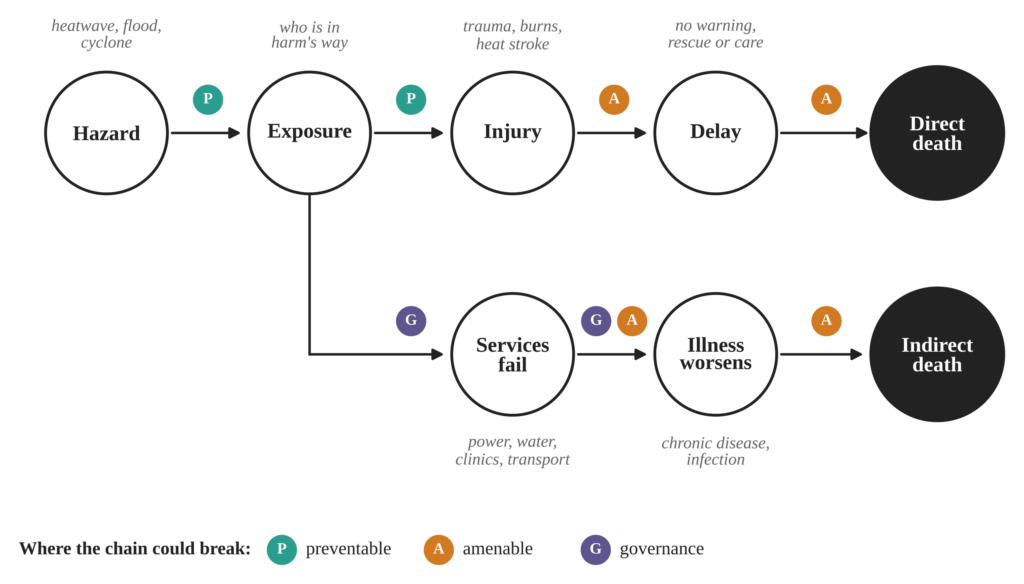
Figure 1: Direct and indirect causal pathways to disaster deaths, and where preventable (P), amenable (A) and governance (G) measures can break each link. Source: authors.
Indirect deaths are easily missed. After Hurricane Maria struck Puerto Rico in 2017, about one third of deaths in the following months were attributed to delayed or interrupted health care (Kishore et al., 2018).
Breaking the chain
There is clear evidence that these chains can be broken. Over the past half-century, improved early warnings and coordinated disaster management have greatly reduced the number of people killed by weather- and climate-related disasters (WMO, 2023). Countries with more comprehensive early warning systems experience significantly lower disaster mortality. Yet only 64 of the 136 countries that report having such systems have all four of their parts in place, from understanding risk to being prepared to respond. As the latest global review puts it, “A warning only saves lives if every link in the chain works” (UNDRR, 2026).
Local experience points the same way. After Ahmedabad, India, introduced South Asia’s first heat action plan, an estimated 1,190 deaths were avoided each year (Hess et al., 2018). In Odisha, a clear goal of zero casualties, backed by warnings, shelters and coordinated evacuation, has greatly reduced cyclone deaths (Ray-Bennett, 2018).
From pathways to action
Seeing each death as the end of a causal pathway changes what we do. Instead of only counting deaths, we can learn from each one:
- record both the medical cause and the circumstances of every disaster death;
- count indirect deaths as well as direct ones;
- make sure early warnings reach everyone and lead to action;
- prepare hospitals and clinics to keep working during heatwaves, floods and cyclones;
- make reducing avoidable deaths a measurable goal of climate adaptation plans.
This is not about blame. Each death shows where a system needs strengthening.
Climate change will bring more frequent and more intense hazards. But a hazard becomes deadly only through a chain of events, and every link in that chain is an opportunity to save a life. Disaster deaths are avoidable.
References
Combs, D.L., Quenemoen, L.E., Parrish, R.G. and Davis, J.H. (1999) ‘Assessing disaster-attributed mortality: development and application of a definition and classification matrix’, International Journal of Epidemiology, 28(6), pp. 1124–1129. Available at: https://doi.org/10.1093/ije/28.6.1124.
Hess, J.J. et al. (2018) ‘Building resilience to climate change: pilot evaluation of the impact of India’s first heat action plan on all-cause mortality’, Journal of Environmental and Public Health, 2018, 7973519. Available at: https://doi.org/10.1155/2018/7973519.
IPCC (2023) ‘Summary for policymakers’, in Climate change 2023: synthesis report. Contribution of Working Groups I, II and III to the Sixth Assessment Report of the Intergovernmental Panel on Climate Change. Geneva: IPCC, pp. 1–34. Available at: https://doi.org/10.59327/IPCC/AR6-9789291691647.001.
Jonkman, S.N. and Kelman, I. (2005) ‘An analysis of the causes and circumstances of flood disaster deaths’, Disasters, 29(1), pp. 75–97. Available at: https://doi.org/10.1111/j.0361-3666.2005.00275.x.
Kishore, N. et al. (2018) ‘Mortality in Puerto Rico after Hurricane Maria’, New England Journal of Medicine, 379(2), pp. 162–170. Available at: https://doi.org/10.1056/NEJMsa1803972.
Ray-Bennett, N.S. (2025) Avoiding disaster deaths: Why do so many people die? Springer Nature, Switzerland.
Ray-Bennett, N.S. (2018) Avoidable deaths: a systems failure approach to disaster risk management. Springer Nature Brief, Switzerland.
UNDRR (2026) Global status of multi-hazard early warning systems 2026. Geneva: United Nations Office for Disaster Risk Reduction. Available at: https://www.undrr.org/reports/global-status-mhews-2026 (Accessed: 16 November 2026).
WHO Regional Office for Europe (2026) ‘Statement: Europe lost 200 000 people to heat in 4 years, yet nearly all of them were preventable’, 11 June. Available at: https://www.who.int/europe/news/item/11-06-2026-statement—europe-lost-200-000-people-to-heat-in-4-years-yet-nearly-all-of-them-were-preventable (Accessed: 16 November 2026).
WMO (2023) Atlas of mortality and economic losses from weather, climate and water-related hazards (1970–2021). Geneva: World Meteorological Organization. Available at: https://wmo.int/publication-series/atlas-of-mortality-and-economic-losses-from-weather-climate-and-water-related-hazards-1970-2021 (Accessed: 16 November 2026).