

Case Station for Avoidable Tsunami Deaths
By Dr Hideyuki Shiroshita
For over a decade, Junior Champions at Hama Elementary School in Izumiotsu have been working to reduce tsunami-related deaths. According to tsunami hazard and damage estimates provided by the prefectural government, the city could face a tsunami of up to 4.4 metres, with more than 2,000 potential fatalities under a worst-case scenario. However, this outcome assumes delayed evacuation. If residents are aware of tsunami risks and evacuate immediately after an earthquake, everyone in the city has enough time to escape. Recognising this gap between risk perception and reality, the Junior Champions began their challenge: to communicate this vital fact to community members and help prevent avoidable tsunami deaths.
This year, 44 Junior Champions joined ADN’s Tsunami Avoidable Deaths Project. As in previous years, an initial meeting took place in May between Dr Shiroshita, his student, and teachers at Hama Elementary School to determine the focus of that year’s activities. Teachers showed strong interest in evacuation shelters and indirect disaster-related deaths, while Dr Shiroshita’s student suggested creating a song on Disaster Risk Reduction (DRR).
Following these discussions, two separate but interconnected sub-projects were launched. The first focused on establishing the city’s disaster relief stockpile facility, known as OZU-BO, while the second centred on creating a DRR song. Both projects aim to reduce tsunami-related fatalities, but through different methods. The OZU-BO project addresses indirect tsunami deaths, which often occur during prolonged sheltering, whereas the DRR song targets direct tsunami deaths by encouraging preparedness and quick evacuation.
This year, the City of Izumiotsu transformed its former library building into a disaster relief stockpile centre called OZU-BO. “Ozu” refers to the city’s former name, while “BO” is derived from bosai, the Japanese term for Disaster Risk Reduction. The establishment of OZU-BO was based on lessons learned from the 2024 Noto Peninsula Earthquake. Izumiotsu City sent 25 staff members to support disaster relief efforts in the affected area, where they identified several challenges: large amounts of undelivered relief supplies, limited public knowledge of how to utilise stockpiled items such as emergency toilets, and inadequate sharing of stockpile utilisation plans among staff. In response, the city implemented a new stockpile management system in partnership with a logistics company and created dedicated spaces for practical training in stockpile usage.
Before its official opening, the Junior Champions were given the opportunity to conduct a study tour of OZU-BO for the mayor and city officials. To prepare, they received a special lecture from the head of the city’s disaster management section, learning not only how to use each stockpiled item but also the facility’s background and purpose. They also gained practical experience in using the equipment.
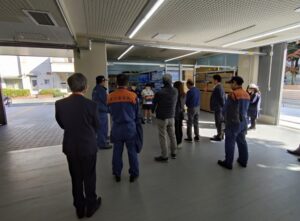
On 27 November, the Junior Champions invited the mayor, city officials, council members, and community-based DRR volunteers to a guided tour of OZU-BO. Approximately 70 people attended. The Junior Champions prepared presentation slides explaining each stockpiled item and demonstrated their use at exhibition tables. The tour received very positive feedback. Through this experience, the Junior Champions deepened their understanding of life in shelters during disasters and of how improving shelter conditions can help prevent indirect deaths from tsunamis.
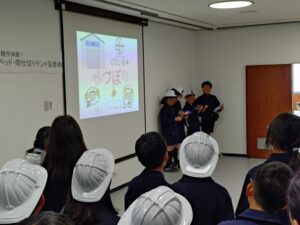
In December, the Junior Champions began working on the DRR song project. They are currently developing the song lyrics, while Dr Shiroshita’s student will compose the music. The themes were discussed in class: Class 1 chose “Social Ties in the Community,” while Class 2 selected “Hope.” After identifying key messages for the lyrics, the student will finalise both the lyrics and composition during the New Year break. From January, the Junior Champions will start practising the song. They plan to invite local residents to perform the DRR song, and in February, they will welcome students from Shuangxi Elementary School in Taiwan. During this exchange, the Junior Champions will guide their Taiwanese peers to OZU-BO and perform the DRR song.
We believe this innovative disaster education programme will help lower both direct and indirect tsunami-related fatalities.